
Preventing Needlestick Injuries
Last Updated 04/2026
English
30-Day Money Back Guarantee
Full Lifetime Access
Finish in
15 min! Run Time
15 min! Run Time
Made for for
Employees
only
Employees
only
Certificate
of Completion
of Completion
Mobile -
Friendly
Access
Friendly
Access
What you'll learn
Identify risky devices and unsafe work practices that can cause needlestick injuries.
Explain employer strategies for preventing needlestick injuries.
Recall and use safer work practices and safer devices to help minimize your risk of a needlestick injury.
Description
Needlestick injuries are among the most frequent and serious occupational hazards faced by healthcare workers — and the consequences can be life-altering. A single accidental puncture from a contaminated needle can expose a worker to more than 20 types of infectious bloodborne pathogens, including Hepatitis B, Hepatitis C, and HIV. Despite being largely preventable, needlestick injuries continue to occur at alarming rates in hospitals, clinics, and other healthcare settings where sharps are routinely used during patient care. This course is designed to equip healthcare workers with the knowledge and practical strategies needed to minimize their risk of needlestick injury and respond appropriately when an exposure incident occurs.
Learners will identify the risky devices and unsafe work practices most commonly associated with needlestick injuries, and explore the employer strategies and regulatory requirements in place to prevent them. The course covers safer work practices for handling, using, and disposing of sharps during patient care, as well as the safer needle devices and engineering controls available to reduce exposure risk. Risk recognition, injury reporting procedures, and post-exposure protocols are also addressed, ensuring employees understand their rights and responsibilities following an incident.
Upon completion, healthcare workers will have the tools and awareness needed to protect themselves from one of the most preventable occupational hazards in the clinical environment.
System Requirements
See System Requirements in the Coggno Knowledge Base
Table of Contents
1. Introduction and Objectives
2. Risk and Reporting
3. Prevention Strategies
4. Safer Devices
Preventing Needlestick Injuries
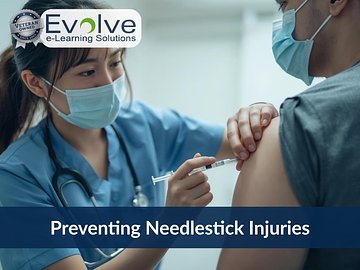
Preventing Needlestick Injuries
Needlestick injuries are among the most frequent and serious occupational hazards faced by healthcare workers — and the consequences can be life-altering. A single accidental puncture from a contaminated needle can expose a worker to more than 20 types of infectious bloodborne pathogens, including Hepatitis B, Hepatitis C, and HIV. Despite being largely preventable, needlestick injuries continue to occur at alarming rates in hospitals, clinics, and other healthcare settings where sharps are routinely used during patient care. This course is designed to equip healthcare workers with the knowledge and practical strategies needed to minimize their risk of needlestick injury and respond appropriately when an exposure incident occurs.
Learners will identify the risky devices and unsafe work practices most commonly associated with needlestick injuries, and explore the employer strategies and regulatory requirements in place to prevent them. The course covers safer work practices for handling, using, and disposing of sharps during patient care, as well as the safer needle devices and engineering controls available to reduce exposure risk. Risk recognition, injury reporting procedures, and post-exposure protocols are also addressed, ensuring employees understand their rights and responsibilities following an incident.
Upon completion, healthcare workers will have the tools and awareness needed to protect themselves from one of the most preventable occupational hazards in the clinical environment.
Learners will identify the risky devices and unsafe work practices most commonly associated with needlestick injuries, and explore the employer strategies and regulatory requirements in place to prevent them. The course covers safer work practices for handling, using, and disposing of sharps during patient care, as well as the safer needle devices and engineering controls available to reduce exposure risk. Risk recognition, injury reporting procedures, and post-exposure protocols are also addressed, ensuring employees understand their rights and responsibilities following an incident.
Upon completion, healthcare workers will have the tools and awareness needed to protect themselves from one of the most preventable occupational hazards in the clinical environment.
Frequently Asked Questions
This course is designed for employees who need to complete Preventing Needlestick Injuries training
Yes. This course is designed to meet applicable federal requirements and commonly mandated state standards. Always confirm specific state or industry requirements with your local regulations.
The course takes approximately 15 minutes to complete and can be paused and resumed at any time.
Yes. Learners receive a downloadable certificate upon successful completion, which can be used for compliance records and audits.
Yes. You can assign this course to individuals or groups using Coggno’s LMS, or purchase multiple seats for your team.
Yes. This course can be exported for delivery in most learning management systems (SCORM compatible).
Yes. The course is fully self-paced and available 24/7.
Yes. This course includes a knowledge check to reinforce learning and verify completion.
Learners have lifetime access from the date of purchase.
Yes. A preview is available so you can review the course format and content before purchasing.
Yes. Content is reviewed and updated as regulations and best practices change.
Yes. This course is available for free with an active Prime Subscription.
Yes. Refund requests can be submitted within 30 days of purchase.
OSHA Compliance
- Bloodborne Pathogens Training (21)
- Electrical Safety (73)
- Fire Safety Training (50)
- First Aid Training (34)
- Forklift Training (45)
- HazCom (Hazard Communication) (51)
- Lockout/Tagout (LOTO) (24)
- OSHA 10 Hour Training (6)
- OSHA 30 Hour Training (2)
- PPE (Personal Protective Equipment) (65)
- Slips, Trips & Falls (72)
- Workplace Safety (1001)