
Latex Allergy
Last Updated 04/2026
English
30-Day Money Back Guarantee
Full Lifetime Access
Finish in
20 min! Run Time
20 min! Run Time
Made for for
Employees
only
Employees
only
Certificate
of Completion
of Completion
Mobile -
Friendly
Access
Friendly
Access
What you'll learn
Describe what latex is and the distinction between natural rubber latex and synthetic rubber.
List occupations and populations at risk for latex allergy.
Explain why latex allergy has grown more prevalent in the last 30 years.
Identify common latex containing products.
Describe the three types of reactions associated with latex allergy and common symptoms.
Identify methods used to diagnose latex allergy; and
Recall ways to prevent or reduce the risk of latex allergy.
Description
Latex allergy has grown from a rarely recognized condition in the late 1970s into a significant occupational health concern affecting healthcare workers across all clinical settings. It is estimated that 8 to 12 percent of healthcare workers are latex sensitive — with reactions ranging from mild irritant contact dermatitis to severe, potentially life-threatening anaphylactic responses. As latex remains present in a wide range of medical products and equipment, healthcare workers must be equipped to recognize latex-containing products, understand their personal risk, and take appropriate precautions to prevent or manage allergic reactions in themselves and their patients.
This course provides a thorough overview of latex, including the important distinction between natural rubber latex and synthetic rubber, and explains why the prevalence of latex allergy has increased significantly over the past several decades. Learners will identify common latex-containing products found in healthcare environments, explore the three types of latex reactions and their associated symptoms, and learn how latex allergy is diagnosed. The course concludes with practical prevention strategies and workplace controls that employees can apply to reduce their risk of exposure and allergic response.
Upon completion, healthcare workers will have the knowledge needed to protect themselves and their patients from latex-related health risks in the clinical environment
System Requirements
See System Requirements in the Coggno Knowledge Base
Table of Contents
1. Introduction and Objectives
2. A Closer Look at Latex
3. Latex Reactions and Symptoms
4. Diagnosis and Prevention
Latex Allergy
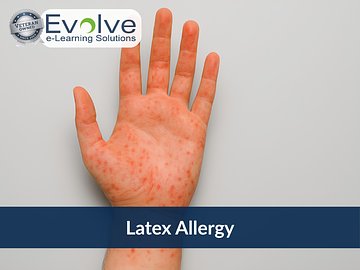
Latex Allergy
Latex allergy has grown from a rarely recognized condition in the late 1970s into a significant occupational health concern affecting healthcare workers across all clinical settings. It is estimated that 8 to 12 percent of healthcare workers are latex sensitive — with reactions ranging from mild irritant contact dermatitis to severe, potentially life-threatening anaphylactic responses. As latex remains present in a wide range of medical products and equipment, healthcare workers must be equipped to recognize latex-containing products, understand their personal risk, and take appropriate precautions to prevent or manage allergic reactions in themselves and their patients.
This course provides a thorough overview of latex, including the important distinction between natural rubber latex and synthetic rubber, and explains why the prevalence of latex allergy has increased significantly over the past several decades. Learners will identify common latex-containing products found in healthcare environments, explore the three types of latex reactions and their associated symptoms, and learn how latex allergy is diagnosed. The course concludes with practical prevention strategies and workplace controls that employees can apply to reduce their risk of exposure and allergic response.
Upon completion, healthcare workers will have the knowledge needed to protect themselves and their patients from latex-related health risks in the clinical environment
This course provides a thorough overview of latex, including the important distinction between natural rubber latex and synthetic rubber, and explains why the prevalence of latex allergy has increased significantly over the past several decades. Learners will identify common latex-containing products found in healthcare environments, explore the three types of latex reactions and their associated symptoms, and learn how latex allergy is diagnosed. The course concludes with practical prevention strategies and workplace controls that employees can apply to reduce their risk of exposure and allergic response.
Upon completion, healthcare workers will have the knowledge needed to protect themselves and their patients from latex-related health risks in the clinical environment
Frequently Asked Questions
This course is designed for employees who need to complete Latex Allergy training
Yes. This course is designed to meet applicable federal requirements and commonly mandated state standards. Always confirm specific state or industry requirements with your local regulations.
The course takes approximately 20 minutes to complete and can be paused and resumed at any time.
Yes. Learners receive a downloadable certificate upon successful completion, which can be used for compliance records and audits.
Yes. You can assign this course to individuals or groups using Coggno’s LMS, or purchase multiple seats for your team.
Yes. This course can be exported for delivery in most learning management systems (SCORM compatible).
Yes. The course is fully self-paced and available 24/7.
Yes. This course includes a knowledge check to reinforce learning and verify completion.
Learners have lifetime access from the date of purchase.
Yes. A preview is available so you can review the course format and content before purchasing.
Yes. Content is reviewed and updated as regulations and best practices change.
Yes. This course is available for free with an active Prime Subscription.
Yes. Refund requests can be submitted within 30 days of purchase.
OSHA Compliance
- Bloodborne Pathogens Training (21)
- Electrical Safety (73)
- Fire Safety Training (50)
- First Aid Training (34)
- Forklift Training (45)
- HazCom (Hazard Communication) (51)
- Lockout/Tagout (LOTO) (24)
- OSHA 10 Hour Training (6)
- OSHA 30 Hour Training (2)
- PPE (Personal Protective Equipment) (65)
- Slips, Trips & Falls (72)
- Workplace Safety (1001)